Women, AI and democracy
Democracy is unequal when information is.

Section: The gap
Participation begins where information is held.
A woman who does not know a budget exists cannot question it. A woman who does not know a school has a repair allocation cannot ask why the roof still leaks. The barrier is rarely interest — it is access, language and the unwritten rule that someone else will do the asking.
Data
A connection, a data bundle, and a phone that is hers to use.
Literacy
Text-first interfaces assume reading fluency in a second language.
Permission
Shared devices and household norms can make asking visible.
Language
Records exist in a language the office uses, not the one she speaks.
Jamhooriyat Saheliyan treats AI as a way to lower those barriers — never as a substitute for women's own judgement, or for institutions' duty to answer.
Section: Our approach
Five commitments that decide how we build.
Co-created
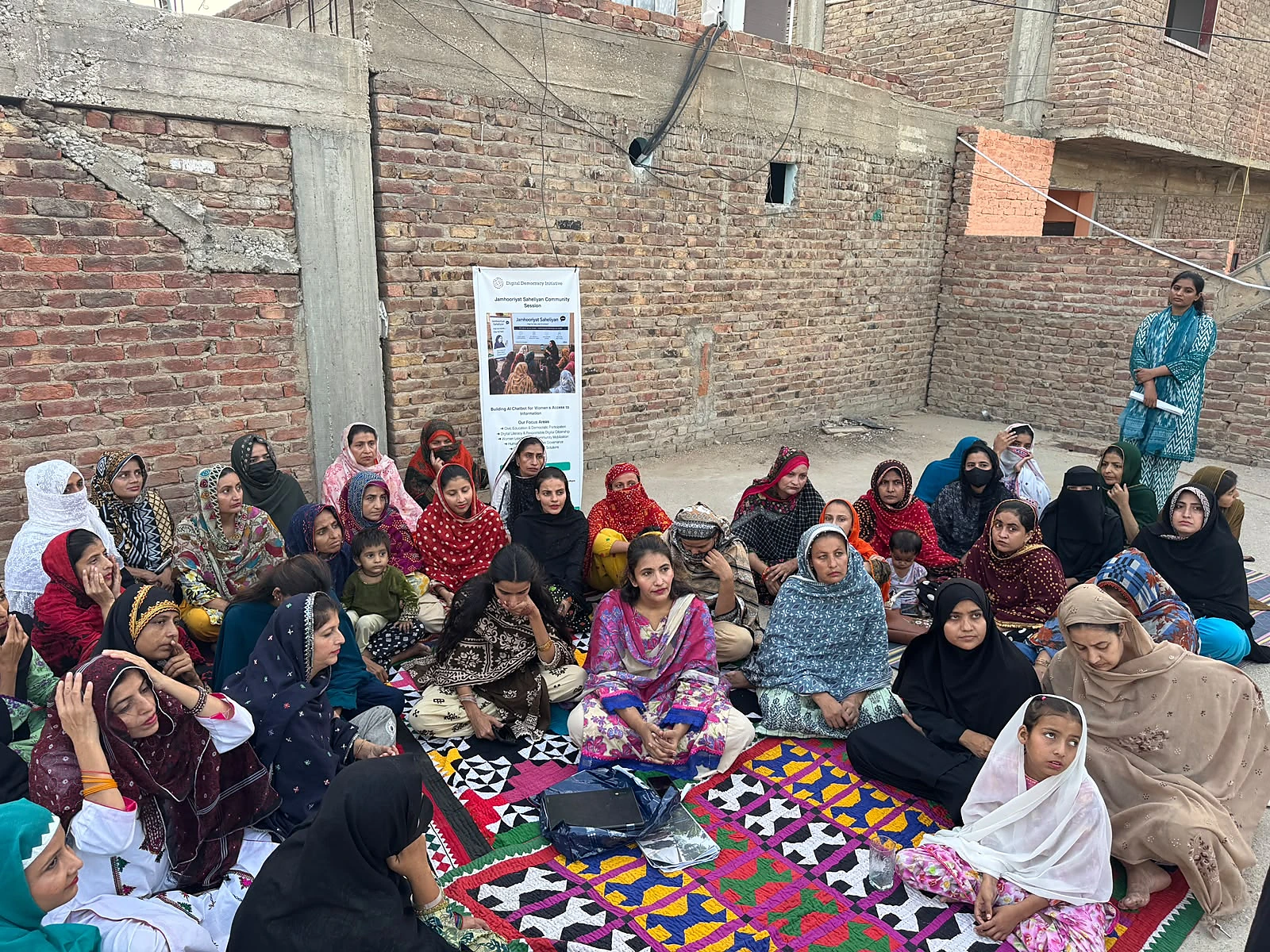
Women shaped the tool from the start — the questions it answers, the words it uses, and where it stops.
Accessible
Local language, simple prompts, a familiar app, and an assumption that the phone may be shared.
Responsible
Informed consent, minimal data, clear limits, and a human follow-up whenever it is needed.
Honest
We say what the tool can and cannot do. Every feature is labelled live or in development.
Collective
Individual access becomes power when women act together. The network is not an add-on.
Section: Responsible AI, in practice
Small model, narrow job, human handover.
A narrow job
The service explains process and points to the right office. It does not give legal opinions or predict outcomes.
Minimal data
We ask for what the question needs and nothing more. No profiling, no advertising, no resale.
Visible limits
When a question is outside what the service can answer, it says so and hands over to a person.
Human follow-up
Community facilitators support first use and step in when a request stalls.
Auditable answers
Replies name the source of the information, so a woman can check it herself.
Section: Digital inclusion
Technology alone does not remove structural inequality.
Who is in the room
Decisions improve when the women living with the consequences are present — not represented by someone else.
Who can ask
A right nobody knows they have is not yet a right in practice. Access work is democracy work.
Who answers
Accountability is a relationship. The network keeps the question alive long enough to get an answer.
Research and partnership
Test these assumptions with us.
We report what works and what does not. Research partners can help us strengthen language support, safety and evidence.